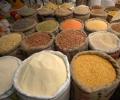
Now the PMO needs to take the food sector reforms forward.
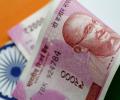
Defence outlay alone will jump 22 per cent

The US on Tuesday made an offer to reduce its overall trade distorting subsidy to $15 billion. India's commerce and industry minister on Wednesday rejoined the crucial negotiations to break the Doha deadlock after his government won a confidence vote in Parliament on Tuesday.

The savings would be better spent and might actually reach the poor, says Rahul Khullar.

Already, the government's resources are strained due to various fiscal stimulus and the Survey has separately noted that high growth environment creates scope for partial rollback of these stimuli.

Against the Reserve Bank of India's (RBI's) projection of 7.1 per cent, India's first quarter (Q1) 2024-25 (FY25) gross domestic product (GDP) growth came in at 6.7 per cent. This is in line with market expectations and significantly lower than the 7.8 per cent recorded in the fourth quarter (Q4) 2023-24 (FY24) and 8.2 per cent in Q1FY24. The quarter witnessed decreased government consumption and investment spending due to the parliamentary election.
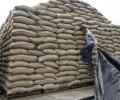
Wheat will be now be sold to the schemes at Rs 2 per kg, while rice would be given at Rs 3 per kg.

Union finance secretary T V Somanathan recently said the Centre had saved Rs 10,000 crore in FY22 on interest payments after adopting new accounting mechanisms for central government agencies and centrally sponsored schemes (CSS) for state governments. Speaking at an event, Somanathan said due to these, there was an unspent balance of Rs 1.2 trillion with state agencies from CSS as on March 31, 2022. This means this amount will be reduced from the Centre's borrowing for now and it can be considered a short-term saving for the exchequer.

The supplementary demands for grants include a gross additional spending of over Rs 2 lakh crore, which would be matched by savings of over Rs 1.21 lakh crore.
The Reserve Bank on Tuesday said the government should deregulate diesel prices in order to contain the trade deficit, which is expected to widen to $160 billion during the current fiscal.

'Several businesses like entertainment, hospitality, travel etc would never be the same again.'

Congress deputy leader in Lok Sabha Gaurav Gogoi claimed in a social media post that the website of the Ministry of Food Processing shows the CM's wife Riniki Bhuyan Sarma's firm Pride East Entertainments Pvt Ltd has received Rs 10 crore as part of credit credit-linked subsidy.

India decided last week not to ratify WTO's Trade Facilitation Agreement.

Two days ago, External Affairs Minister S Jaishankar asserted that Pakistan-occupied Kashmir was, is and will always be part of India.

Government sought Parliament's approval to spend an additional Rs 49,715.54 crore to meet the outgo subsidies.

Government should focus on five areas in this year's Budget, says Sunanda Sen, a former professor at Jawaharlal Nehru University.
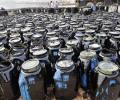
The government's subsidy bill towards oil, fertilisers runs into lakhs of crores of rupees.
The much publicised Unique Identification number may not be as infallible as it is touted to be. Though Aadhaar -- the implementation programme of the UID -- records both the biometric and iris scan data of the individual, it is solely dependent on biometrics for application. The government aims to have biometric authentication readers at ration shops to ensure that only eligible candidates get access to food subsidy and other benefits.
Earlier this year, the US accused India and China of exceeding the WTO limits on farm subsidies, saying these caused trade distortion.
Referring to high oil, food and metal prices across the world that has left an increased pressure on inflation, Nath said the present global food market scenario was a call on the economies of the South East Asian region to remap their positions and reallocate resources. Pointing out that several countries had taken steps to scrap export of food products, the minister said India had announced the National Policy for Farmers.
The recently promulgated National Food Security Ordinance might breach the global trading rules on agriculture under the World Trade Organization if there is diversion of the subsidised foodgrain for export.

Fitch Ratings on Thursday raised its forecast for India's economic growth to 7 per cent for the next fiscal year starting April 1 on the back of strong domestic demand and sustained level of business and consumer confidence. With a stronger-than-expected 8.4 per cent growth in gross domestic product (GDP) during the third quarter (October-December) of the current fiscal year, Fitch saw the Indian economy expanding 7.8 per cent in 2023-24 financial year (April 2023 to March 2024), marginally higher than the government's estimate of 7.6 per cent.
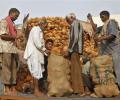
The decision preceded long hours of tense negotiations and last minute hiccups from Argentina and Pakistan

He conveyed India's position to visiting Director General of the Food and Agriculture Organization Jose Graziano da Silva whom he urged to take the lead in protecting the interests of the poor and farmers at the World Trade Organisation.

According to the final draft of the negotiating text circulated by WTO Director-General Roberto Azevedo among trade ministers of the 159 member countries on Wednesday night, on public stockholding for food security purposes, a developing country like India can provide subsidies for farm support even if those exceed the permissible 10 per cent cap.

Economist Abhijit Sen, a former Planning Commission member and one of the country's foremost experts on rural economy, died on Monday night. He was 72.

For all its claims to economic glory, the majority of India's population lives vulnerable lives, a situation that has only worsened over the past 15 years, to the extent that the government now fears to release economic data or even conduct a proper Census, notes Rathin Roy.

'The BJP's numbers in this government are almost the same as those enjoyed by the Congress under P V Narasimha Rao when the reform process was kicked off in 1991.' 'As before, the only constraints on the prime minister's actions are internal, not external.' 'They come from his own assessment of the political consequences of any action,' points out Mihir S Sharma.

In a big push to the production-linked incentive (PLI) scheme, the government has nearly doubled (increase of 81 per cent) the allocation in five key industry segments from Rs 8,405 crore in the Revised Estimate of FY24 to Rs 15,198 crore in the Interim Budget for FY25. The segments cover over eight PLI schemes, including mobile phones, IT hardware, pharma (PLIs for medical devices, intermediates and pharmaceuticals), food processing, telecom hardware and, auto and auto components. In FY24, DPIIT officials, however, said that the disbursements would be much higher at around Rs 11,000 crore than what has been budgeted for the year.

The Bill at best makes the existing public distribution system a legal right, an aspect that seems of little consequence to the lords of high finance, whose primary anxiety is the FSB-by-numbers.
.jpg)
Kerry said this in a newspaper article co-authored by US Commerce Secretary Penny Pritzker.

But the government will present a second tranche of Supplementary Demands for Grants during the Budget session of Parliament in February, when it can seek additional spending.
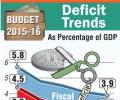
Finance Minister Arun Jaitley presented the Budget today.

The stock and foreign exchange markets have had a negative reaction to the government's biggest social security programme, the National Food Security Bill. Food minister K V Thomas questions the rationale behind such a response

The government's fiscal deficits have reduced over the last five years.

India is threatening to block the World Trade Organization (WTO)'s trade facilitation agreement (TFA) reached at Bali last year unless its agricultural policies are permanently excluded from multilateral scrutiny.

The central government is on track to meet its fiscal deficit target of 6.4 per cent of the GDP for 2022-23 on the back of strong growth in revenue collections, the World Bank said in its India Development Update on Tuesday. High nominal GDP growth in the first quarter supported strong growth in revenue collection, especially Goods and Services Tax (GST), despite tax cuts on fuel. Notwithstanding an increase in spending due to expanded fertilizer subsidies and food subsidies for vulnerable households in response to the commodity price shock, the government is on track to meet its FY22/23 fiscal deficit target of 6.4 per cent of GDP and the general government deficit is projected to decline to 9.6 per cent from 10.3 per cent in FY21/22 and 13.3 per cent in FY20/21.

Do the actual numbers bear out the claims made by the government or do they suggest something else? asks A K Bhattacharya.

The biggest headwind to the consumption story in FY23 is a sharp decline in government subsidies on food, fertiliser and fuel, and overall decline in revenue expenditure net of interest payments. This, analysts say, will adversely impact purchasing power of households at the lower end of the income pyramid, translating into lower spending on consumer goods and services.
